Cash Flow Management for Small Service Businesses: A Calm, Repeatable Rhythm
You manage cash flow calmly by keeping the look small enough to face and steady enough to repeat. Three questions, on the same day each week, asked while the answers are still boring. What cash is actually here? What is already spoken for, and on what date? What is owed to you, and how late it has become? Every other money decision you make sits downstream of those three answers.
If the phrase “the same day each week” already made something tighten, that reaction deserves respect rather than override. You aren’t disorganized. You’ve probably been checking your bank balance five times a day and calling it management, because the balance is the one number that never asks you to interpret anything.
Your nervous system has been keeping the receipts on every month the balance looked fine and then didn’t. That’s why the balance stopped being reassuring. It shows you a single moment with no dates attached, and dates are the whole problem in a service business.
The timing matters. So does the person reading it, because a rhythm nobody can stand to keep isn’t a system. It’s a resolution.
Prosperity First works with established service-based owners who are earning well and still can’t say, on a Tuesday, whether the money sitting in the account is theirs to spend. The work combines bookkeeping, CFO-level interpretation, and coaching, so the rhythm has something real to land on.
Estimated reading time: 14 min read
TLDR: Before the full guide
A calm cash rhythm has two loops and one rule. Weekly, you look at cash on hand, dated obligations, and unpaid invoices, then make one decision. Monthly, you look at the pattern underneath those numbers and change something structural. The rule is that your thresholds get decided in advance, while you’re calm, instead of in the moment the shortfall arrives. What each look contains, and what decision it feeds, is below.
Keep reading for the complete guide.
What this guide covers
- Your Cash Problem Is Often a Timing Problem
- Sort the Money by How Certain It Is
- The Weekly Look: Four Things, One Decision
- The Monthly Pass: What the Weekly Look Can’t See
- Decide Your Thresholds Before You Need Them
- Where Borrowing Belongs in the Sequence
- When the Rhythm Needs Someone Else in the Room
Your Cash Problem Is Often a Timing Problem
In a service business, the work and the money run on different clocks.
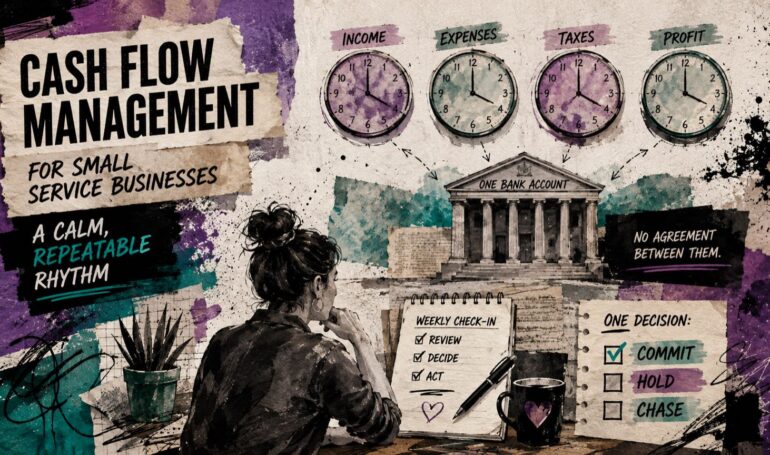
Three clocks, really. The work gets delivered on one. The invoice goes out on another. The cash lands on a third, whenever the client’s accounts payable process gets around to it. Meanwhile payroll, contractors, and subscriptions run on a fourth clock that never slips and never negotiates.
Timing is one common gap, but first confirm that the underlying model is profitable. Four clocks, one bank account, and no agreement between them.
You can have a profitable quarter and a frightening Thursday inside it. Profit is a story about a period. Cash is a story about a date. A deposit collected in June for work you deliver in September is money the business still owes work against, which means part of that balance is spoken for by delivery you haven’t done yet.
Service models make this sharper. Retainers smooth it. Milestone billing stretches it. Contractor-heavy delivery inverts it, because you pay the people doing the work before the client pays you for it. Client concentration multiplies all of it, since one slow payer becomes your entire cash position.
Before you build a rhythm, name your own timing shape:
- How many days pass between finishing work and sending the invoice?
- What are your stated payment terms, and what do clients actually do with them?
- Which outgoing payments are fixed to a date you don’t control?
- If your largest client paid three weeks late, what would you not be able to cover?
The last question is usually the one that’s never been asked out loud.
Sort the Money by How Certain It Is
The balance in your account is a mixed number. Part of it is yours, and part of it already belongs to somebody else on a date that’s already set. Sorting by certainty is how you protect the part that’s actually yours to keep, which is the number your life gets to run on.
Sort it into three groups, and keep the groups honest. Committed money is already spoken for on a known date: payroll, the payroll taxes set aside alongside it, contractors, rent, insurance, debt payments, and the income tax you will owe. Likely money is invoiced and inside terms. Delayed money is invoiced and past terms; past-term invoices should be treated cautiously and probability-weighted rather than assumed available.
What’s left after committed money comes out is your cash remaining after known commitments. It’s almost always a smaller number than the balance, and seeing it once is a strange kind of relief. The dread of an unknown number is heavier than the weight of a known one.
Tax belongs in the committed column, not the available one. The IRS divides the year into four payment periods, each with its own due date. Individuals including sole proprietors, partners, and S corporation shareholders generally have to make estimated payments if they expect to owe $1,000 or more. That’s a calendar fact. Calendar facts are exactly what a cash rhythm is for. What you owe, and how you should handle it, belongs to your tax professional. What the rhythm does is stop that money from looking spendable in the weeks before it leaves.
If you want the allocation side of this, including how to decide what a fat month is allowed to do, that question’s answered in How Do I Stop Feast-or-Famine Without White-Knuckling It?. This article is about the look itself.
The Weekly Look: Four Things, One Decision
The weekly look is short by design, because a look you can tolerate is a look you’ll actually take. It stays the same size every week, it happens on a named day, and it always ends in a decision.
Four things to see: cash on hand; dated obligations landing in the next two weeks; unpaid invoices, sorted by how old they are rather than how large, and anything you committed to since the last look, including the quiet commitments like a new subscription or a contractor you verbally approved.
Then one decision, chosen from three. Commit, meaning you can safely say yes to the spend, the hire, or the draw. Hold, meaning the answer is yes, on a later week. Chase, meaning the constraint lives in collection, and the next action belongs to whoever follows up on invoices.
That’s it. Orientation. The proof that it’s working shows up in your chest on a Thursday afternoon, when the bracing eases because the week already has a shape written down.
The U.S. Small Business Administration lists accounts receivable, accounts payable, available cash, bank reconciliation, and payroll as the functions someone in your business needs to be managing. Notice that four of those five show up in the weekly look. The weekly look is the reporting layer of work that’s already happening. It only feels heavy when the underlying records are unreliable.
If the harder question for you is how often to look at anything at all, that rhythm is mapped in I Spiral When I Review My Finances. How Often Should I Look at Them?, which covers the weekly, monthly, quarterly, and annual layers as a whole.
The Monthly Pass: What the Weekly Look Can’t See
Weekly answers “can I cover this?” Monthly answers “is this getting better or worse?” Weekly keeps you upright. Monthly is where you read the math running underneath the money, and that math sets what the business can hold.
Once a month, look at the pattern instead of the position. How long is money actually taking to arrive, and is that number moving? Which clients pay on terms and which ones have quietly trained you to expect a delay? What share of the month’s income came from one relationship? Did anything become a fixed cost while you weren’t watching? This is also the look that shows you where the winter is in your business: the stretch of the year that reliably runs cold, months before you’re standing in it.
Receivables are one common pressure point. The follow-up fails because nobody owns it. A collection system has four parts. Terms stated before the work starts. An invoice trigger tied to an event rather than a mood. A reminder schedule that runs whether or not anyone feels awkward. A named person who owns the escalation step. If that person is you, the schedule matters more, not less.
And it’s worth saying plainly what a slow payer actually is. When a larger company holds your invoice for an extra three weeks, it’s financing its own operations with your working capital, and the cost of that arrangement lands on the smallest business in the chain every time. Multiply that across a whole economy of independent operators and you have a quiet transfer of wealth upward that nobody signed. A reminder schedule is a small thing. It’s also how you stop funding somebody else’s cash flow with your own.
The monthly pass feeds structural decisions. Change the terms. Change the invoice timing. Change a price. Change who you take on. Those are the levers that move next quarter’s cash, and none of them can be pulled from a weekly look.
Decide Your Thresholds Before You Need Them
Calm is mostly pre-decision.
Cash management feels emotionally expensive because most owners make the hard calls at their lowest capacity. Payroll is three days out. The client isn’t answering email. So make those calls now, in writing, while nothing is on fire:
- At what age does an unpaid invoice trigger a firmer follow-up, and what does that follow-up say?
- Below what cash figure does discretionary spending pause automatically?
- Below what figure does your own draw change, and by how much?
- What’s the point where you stop solving this alone and bring in support?
Write the answers down. A threshold you wrote in a calm week is a different instrument than a judgment you make in a frightened one. The paper holds the boundary so your body doesn’t have to.
Where Borrowing Belongs in the Sequence
Credit is a legitimate tool. Credit belongs after or alongside diagnosis, not as a substitute for understanding the shortfall.
The Federal Reserve Banks’ 2026 Report on Employer Firms found that 60% of the employer firms in the Federal Reserve Banks’ latest survey applied for financing in the 12 months before it, and the most common reason was to meet operating expenses, at 56%. So if you’ve reached for credit to cover a timing gap, you’re in ordinary company.
The same report is worth reading for the second half of the sentence. Among applicants, 42% received the full amount they sought, 36% received some or most, and 22% received none. Financing isn’t a guaranteed repair for a shortfall, which is the argument for having the conversation early, with your books current, rather than in the week you need the money.
The sequence that keeps this calm is simple: find the timing gap. Name its cause. Change what you can change in collections, commitments, capacity, or pricing. Then decide whether a line of credit is the right instrument for what’s left, with appropriate financial and legal input for your situation.
When the Rhythm Needs Someone Else in the Room
Two different problems get called “cash flow,” and they need different help.
If the numbers themselves are unreliable, the rhythm has nothing to stand on. Books that are behind, miscategorized, or only cleaned up at tax time will produce a weekly look that tells you nothing and costs you something. That’s a records problem, and Profitable Bookkeeping is where it gets solved.
If the numbers are accurate and you still can’t tell what to do with them, that’s a direction problem. Forecasting, pricing, capacity, reserve targets, and whether to borrow all sit in the interpretation layer, which is what fractional CFO support is for. The signs that you’ve crossed that line are laid out in Clean Books and Still Guessing? You’ve Outgrown Bookkeeping.
Telling those two problems apart comes from pattern recognition built over 30+ years in finance, and Prosperity First reports a 16-year average client retention.
Want a Second Set of Eyes on Your Timing?
Start with one weekly look, on a named day, with the four things in front of you and one decision at the end. If you’d like a second set of eyes on your timing first, the Clarity Call is a 30-minute resonance check. Use the call to test what the cash pattern may mean and whether the engagement fits.
Frequently Asked Questions
Q: How often should a small service business check its cash flow?
A: Weekly for cash position, monthly for pattern. The weekly look covers cash on hand, obligations dated in the next two weeks, unpaid invoices by age, and any new commitments, and it ends in one decision: commit, hold, or chase. The monthly pass looks at collection speed, client concentration, terms compliance, and fixed costs, and it ends in a structural change. Anything more frequent than weekly is often balance-refreshing rather than management, though closer-than-weekly monitoring may be justified where daily obligations or volatility require it.
Q: What’s the difference between profit and cash flow in a service business?
A: Profit describes a period; your cash position describes a date. A service business can be profitable across a quarter and still be unable to cover payroll in a specific week, because work delivered, invoices sent, and cash collected all happen on different clocks while payroll and contractor payments run on a fixed one. Profit tells you whether the model works. Cash tells you whether this week works.
Q: How do I know how much money is actually available to spend?
A: Subtract what’s already committed on a known date from what’s in the account. Committed money includes payroll, the payroll taxes set aside with it, contractors, rent, insurance, debt payments, and the income tax you’ll owe. That leaves your cash remaining after known commitments, and it’s normally lower than the bank balance. Invoices that are past terms should be treated cautiously and probability-weighted rather than assumed available.
Q: Should I use a line of credit when client payments are slow?
A: Credit is a reasonable instrument, and it belongs after the diagnosis rather than instead of it. Among employer firms in the Federal Reserve Banks’ latest survey, meeting operating expenses was the most common reason for seeking financing, and a minority of applicants received the full amount they asked for. Identify the timing gap and its cause first, change what can be changed in collections, commitments, capacity, or pricing, then decide whether borrowing addresses what’s left, with appropriate financial and legal input.
Q: What should my bookkeeper prepare so the rhythm works?
A: Current, correctly categorized books, an accounts receivable aging report, a list of upcoming dated obligations, and reconciled accounts you can trust without re-checking. The SBA names accounts receivable, accounts payable, available cash, bank reconciliation, and payroll as the functions that need managing, and the weekly look is simply reading four of those five. If your bookkeeper can’t produce a receivables aging report on request, that’s the first thing to fix.
Citations
- 2026 Report on Employer Firms: Findings from the 2025 Small Business Credit Survey (Federal Reserve Banks, Small Business Credit Survey). Confirms that 60% of employer firms applied for financing in the prior 12 months, that meeting operating expenses was the most common reason at 56%, and that 42% of applicants received the full amount sought, 36% some or most, and 22% none. https://www.fedsmallbusiness.org/reports/survey/2026/2026-report-on-employer-firms
- Manage your business (U.S. Small Business Administration). Confirms that accounts receivable, accounts payable, available cash, bank reconciliation, and payroll are the accounting functions a small business needs someone to manage. https://www.sba.gov/counseling/manage-your-business/
- Estimated taxes (Internal Revenue Service). Confirms that the year is divided into four estimated-tax payment periods, each with its own due date, and that individuals including sole proprietors, partners, and S corporation shareholders generally must pay estimated tax if they expect to owe $1,000 or more. https://www.irs.gov/businesses/small-businesses-self-employed/estimated-taxes
Related reading
- How Do I Stop Feast-or-Famine Without White-Knuckling It?
- I Spiral When I Review My Finances. How Often Should I Look at Them?
- Why Do I Avoid My Numbers When Business Is Fine?
- Clean Books and Still Guessing? You’ve Outgrown Bookkeeping
From the author of the forthcoming book Profit Is Protest.